
How to Keep Your Business From Depending on Your Memory
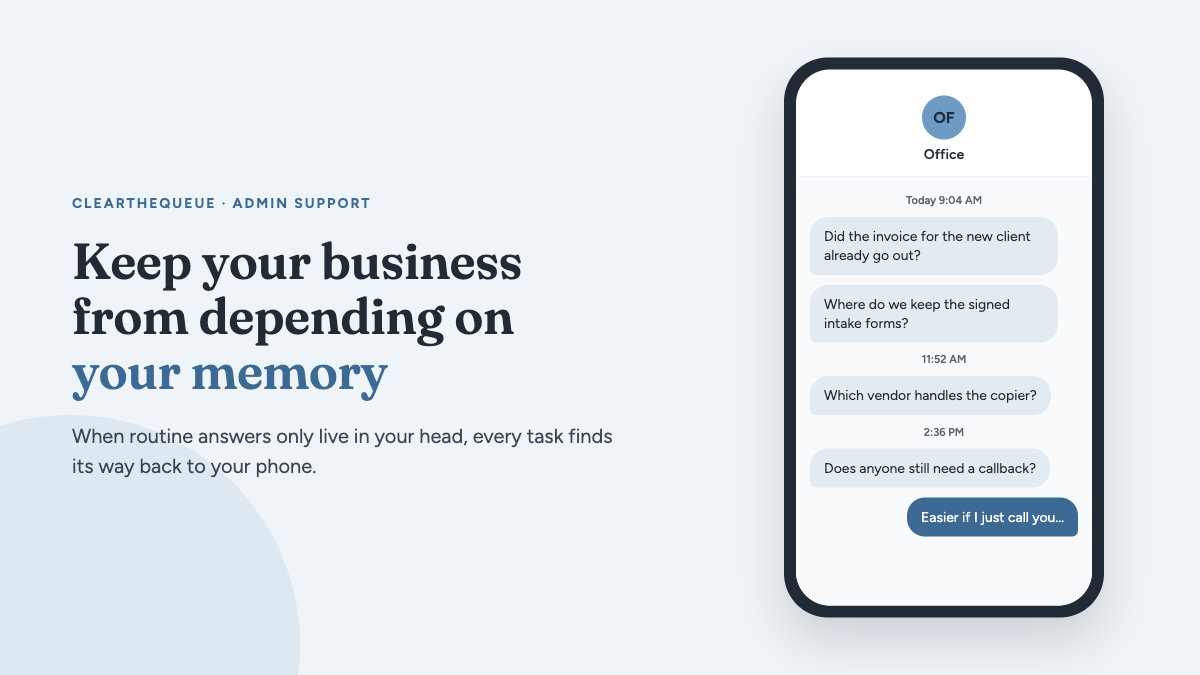
When routine business information only lives in your head, even simple administrative work can keep finding its way back to you.
When routine business information only lives in your head, even simple administrative work can keep finding its way back to you.
If you run a small business, you probably carry a lot of it in your head: which clients are waiting on a callback, where the signed contracts are saved, which vendor fixes the printer, and whether last week's invoice actually went out. That works well enough while you are the one doing everything. The trouble starts when you hire help or step away for a day and realize that nobody can finish a routine task without asking you first.
I learned this from the other side of the desk. In my second week at a new job, the owners left the country on a last-minute trip, and I was suddenly responsible for keeping the office running while I was still learning the business. I didn't know what was already in progress, where things were kept, or how certain situations were usually handled, so I spent that entire week on the phone with them, from the moment I walked in until I closed the office.
The problem wasn't that I couldn't do the work or that they had hired the wrong person. The information I needed simply didn't exist anywhere except in their memories, so every routine task still had to go through them, even from another country. Below is how to keep your business from working that way.
Notice the questions that keep coming back to you
You will always know more about your business than anyone else, and that is normal. The problem starts when someone needs that knowledge to finish routine work and the only way to get it is to ask you.
The easiest way to find those gaps is to pay attention to the calls, texts and "quick questions" you already get. For one week, write down every time someone needs you in order to keep a routine task moving. They might be asking:
where the latest version of a contract or form is saved
who to call when something breaks or a delivery goes wrong
what a new client still needs to send before work can start
whether a payment, quote or reminder has already gone out
who is handling an unfinished task, and when to follow up
The questions that show up again and again are the ones worth fixing first. As your list grows, you'll notice that they fall into two groups, and each group needs a different fix.
Separate how-to information from open work
The first group is how-to information: how things are normally handled. This includes recurring procedures, important contacts, where files are stored, and what to do when a common situation comes up. The second group is open work: anything that currently needs attention, such as callbacks, unpaid invoices, upcoming appointments, missing paperwork and client follow-ups.
During my week covering the office, I was missing both. I didn't know how things were done, and I couldn't see what was already in progress or who was waiting to hear back. The two gaps need different fixes, because a procedure document won't tell anyone that a client expects a call on Thursday, and a task list won't explain how to process a refund. How-to information needs one reliable home, while open work needs to be tracked where everyone can see it.
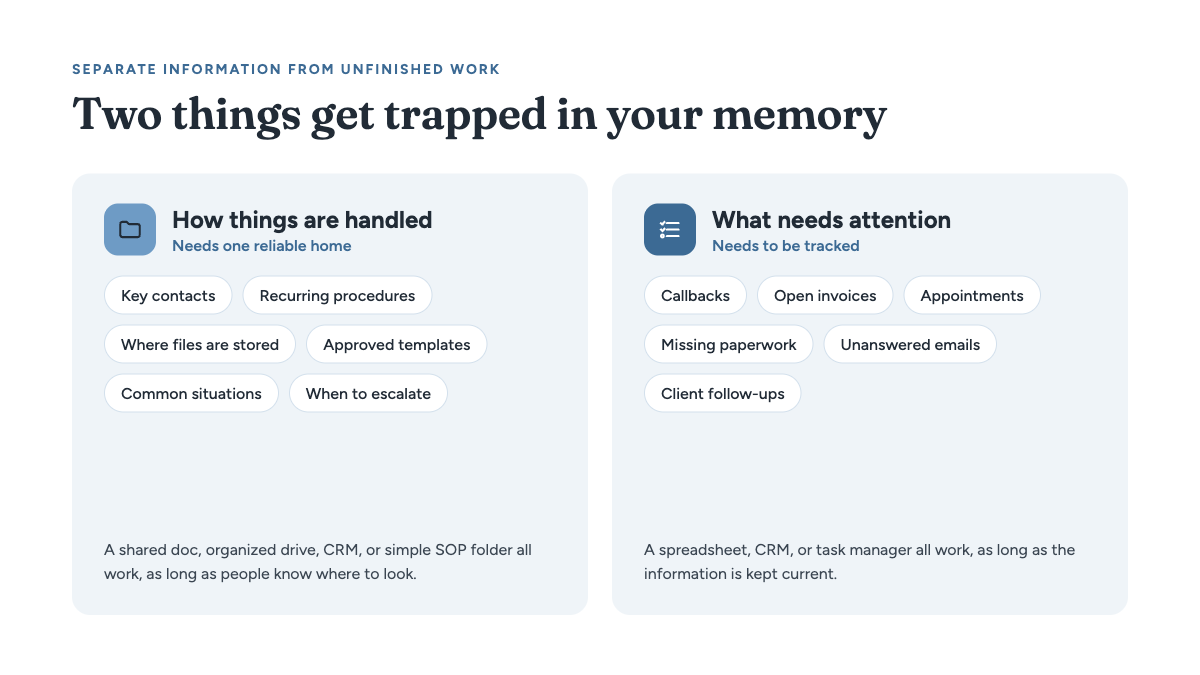
Routine business knowledge needs a reliable place to live. Unfinished work needs a reliable way to be tracked.
Give how-to information one reliable home
You don't need a massive operations manual. Start with the answers to the questions on your list, then add the basics someone would need to handle routine work without interrupting you, such as key contacts, standard procedures, approved templates, and guidance on when something should be brought to you.
Where you keep this information matters less than whether everyone knows where to find it. A shared document, an organized drive, your CRM or a simple folder of written procedures can all work. The goal is not to write down everything you know about the business, but to make the routine answers easy to find.
Make open work visible
When an open task lives only in your memory, your inbox or a text thread, it’s easy for it to slip through the cracks, and nobody else can pick it up. A simple tracker solves this by showing, at a glance, what is still open, who owns it, what happened last, what needs to happen next and when someone should follow up.
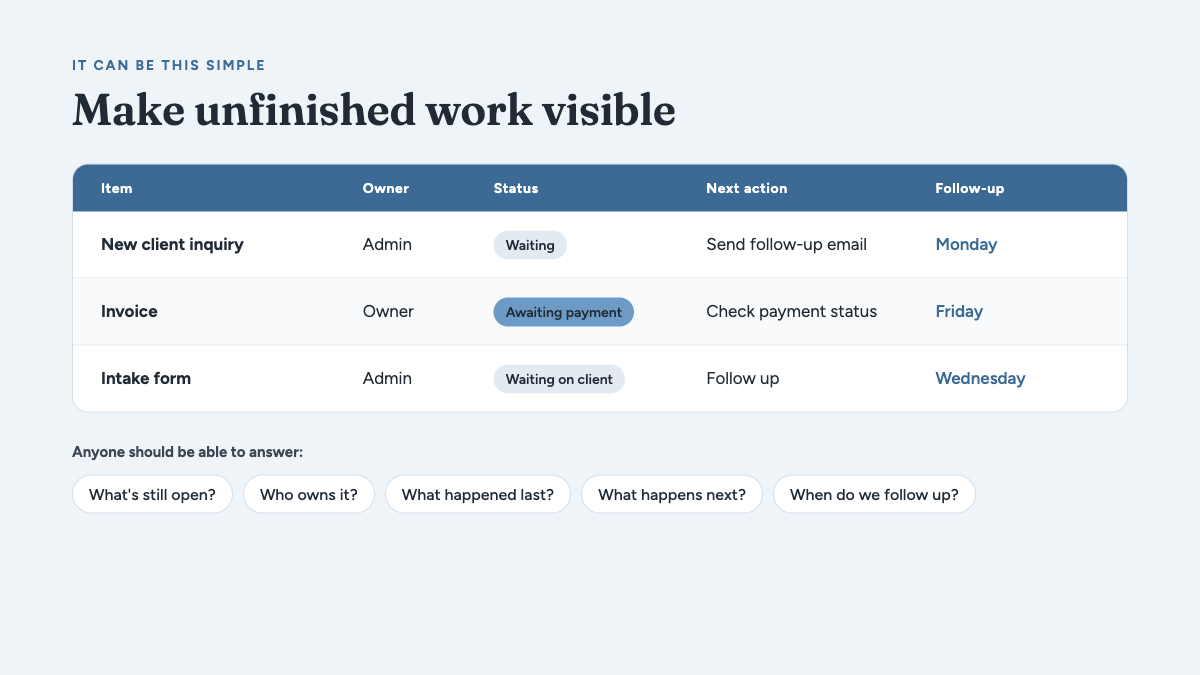
A simple tracker can show what is open, who owns it, what happens next, and when someone needs to follow up.
This doesn't require complicated software. A spreadsheet, CRM or task manager will work, as long as it is kept up to date.
Decide what still needs to come back to you
The point isn't to remove you from your business. Some decisions should still come back to you, including approvals, pricing, exceptions, sensitive issues and major client concerns. Routine work is different. Scheduling, standard follow-ups, updating records, sending approved messages and finding information can usually be handled by someone else once they have the information and a clear sense of where their authority ends.
Spelling this out ahead of time saves everyone guesswork. Your team knows what they can handle on their own, and you stop getting interrupted for things that never needed you in the first place.
Try the one-day absence test
Once you have started, check your progress with a simple test. Imagine you’re completely unavailable for one normal business day. Could someone else see what is still open, find what they need to finish routine tasks, tell who has already been contacted, and know which decisions to save for you? More importantly, how many times would they realistically need to reach you?
Every call or text that wasn't really necessary points to something that still needs to be written down, tracked or clarified. You don't have to fix everything at once. Start with the questions you hear most often, and keep adjusting from there.
Your memory shouldn't be part of the workflow
My week covering the office would have gone very differently if the routine information had been written down and the open work had been easy to see. I still would have had questions, since I was new, but there’s a difference between asking because you are still learning and asking because the answer exists nowhere else.
Your business will always rely on your knowledge to some degree, but its routine work shouldn't rely on your memory. When someone else can see what is happening, find what they need, know what comes next and recognize when to bring you in, your business becomes much easier to delegate, and much easier to step away from.
If reading this made you think of five things that only get done because you remember them, that’s probably a useful clue.
CleartheQueue helps small business owners hand off routine administrative work like follow-ups, scheduling, intake, billing administration, record updates, and other recurring tasks.
Book a free 30-minute consultation to talk through what is still depending on you.