
How to Determine What Administrative Support Your Business Actually Needs
Three weeks into a new job, I told the owner she probably didn't need me full time, at least not in the role I had been hired to fill. I had joined the company as an executive assistant, but after a few weeks of watching how work moved through the business, where time was being lost, and which problems kept repeating, something became obvious: the biggest staffing gap wasn't executive support. The business needed someone dedicated to another function entirely.
The owner disagreed and maintained that a full-time executive assistant was necessary. Several weeks later, I was asked to reduce my schedule because there wasn't enough work to support the original full-time arrangement.
That experience reinforced something I think small-business owners should consider before hiring administrative help: knowing you need help is not the same as knowing what kind of help you need.
Start with the work, not the job title
When you're overwhelmed, it's easy to jump straight to a solution like "I need an assistant." Maybe you do, but that statement alone doesn't tell you what the person should actually be responsible for.
Before choosing a title, make a list of the work you want someone else to handle. For example:
responding to routine emails and messages
scheduling appointments
following up with prospective clients
sending invoices and tracking payments
updating records or a CRM
managing files
coordinating employees in the field
managing your calendar
posting approved social media content
Once the work is in front of you, patterns usually become easier to see.
Figure out what function the work belongs to
Not every task happening inside the same business belongs to the same role:
Administrative support might include scheduling, client follow-up, invoicing, data entry, recordkeeping, or keeping routine communication moving.
Executive support is usually more directly connected to supporting an owner or executive, such as managing their calendar, coordinating meetings, handling correspondence, and helping keep their priorities organized.
Operational work is different because it’s tied more closely to delivering the company's actual service, and it often requires real-time coordination, staffing decisions, or immediate problem-solving.
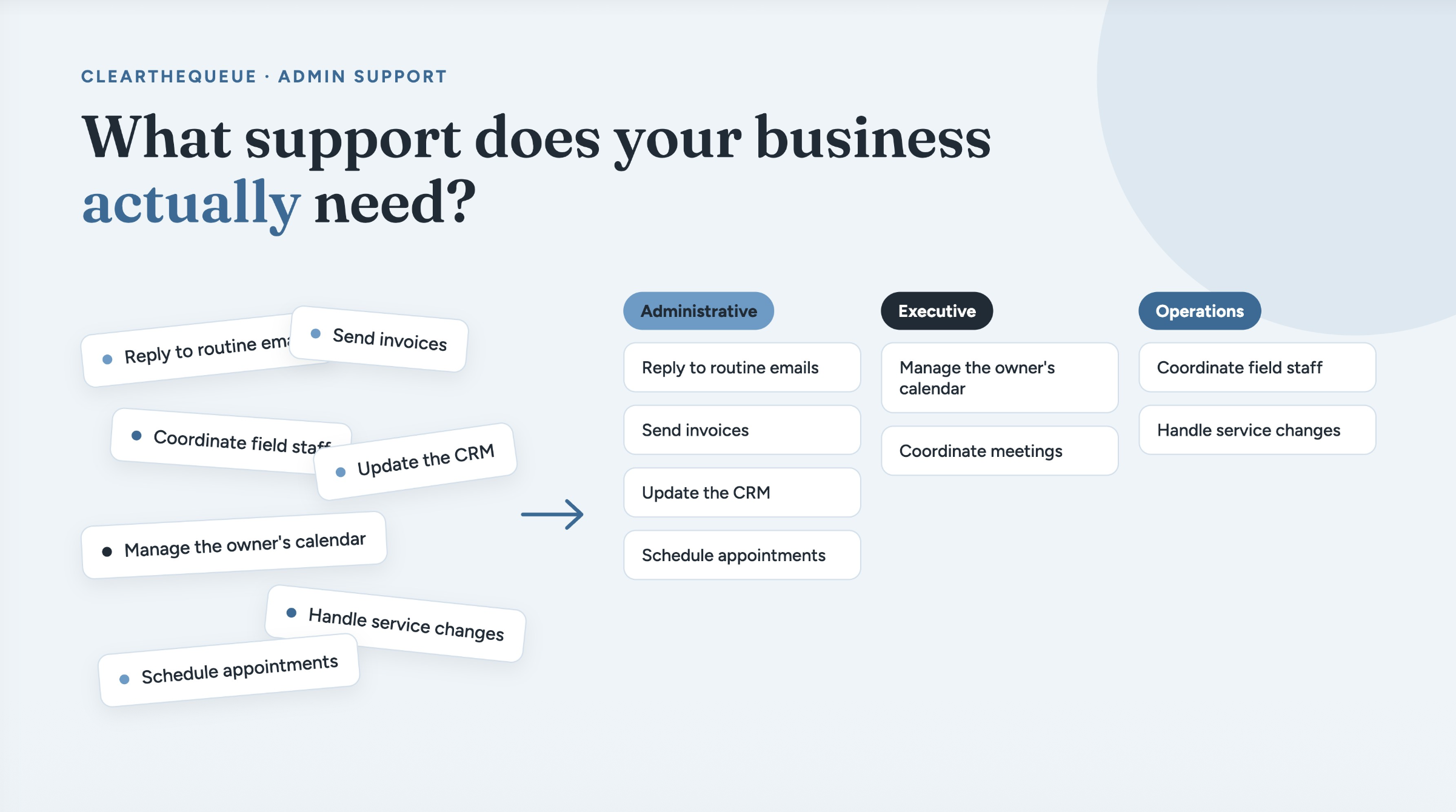
Sorting tasks by function makes it easier to see what kind of help your business actually needs.
Those differences turned out to be pretty important in my case. Although I had been hired as an executive assistant, much of the business's recurring pressure involved coordinating people, schedules, vehicles, and service changes in real time. The company’s problems weren’t going to disappear just because an executive assistant had been hired; the title didn't match the actual need.
Ask how the work needs to be done
Once you know what the work is, ask a second set of questions.
Does it need to happen immediately?
Does someone need to be physically present?
Does the business need continuous coverage, or does it simply need certain tasks completed consistently?
These questions are important because not every administrative task requires someone sitting in an office for eight hours a day. An owner may need emails answered, appointments scheduled, invoices sent, records updated, and clients followed up with on a consistent basis. That can be a genuine business need without necessarily being a full-time position.
Determine how much work actually exists
This is the step I think businesses sometimes skip. Needing administrative help doesn’t automatically mean needing 40 hours of administrative help every week, so take the tasks you identified and estimate:
how often each task happens
approximately how long it takes
whether it happens daily, weekly, or monthly
whether it requires coverage at specific times
whether the workload changes seasonally
You don't need a complicated staffing formula; you just need a realistic picture of the work.
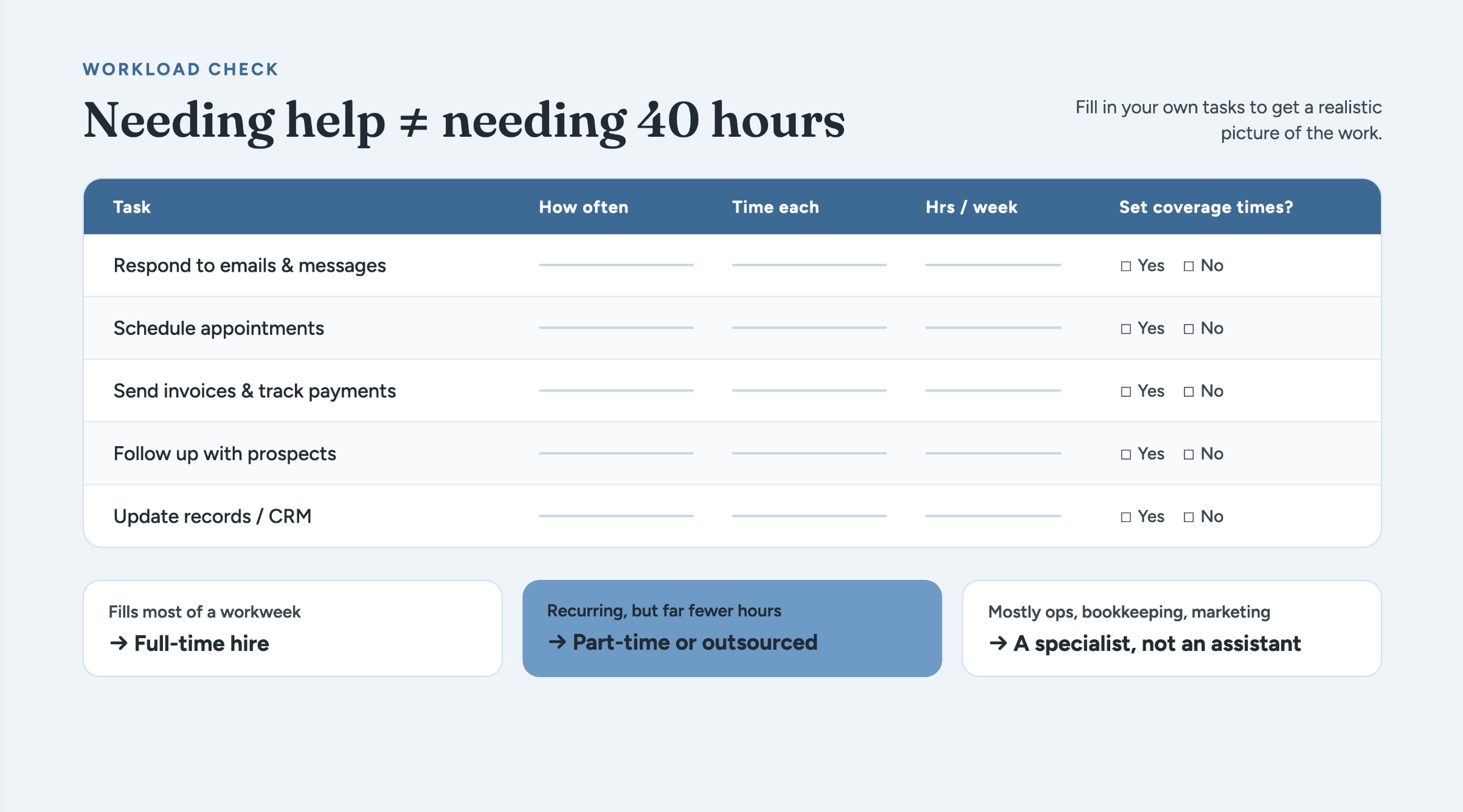
List your recurring tasks and estimate the time each one takes to get a realistic picture of your weekly workload.
If the administrative responsibilities consistently fill most of a workweek, a full-time employee may make sense. If the work is recurring but takes considerably fewer hours, part-time or outsourced support may be a better fit. And if most of the pressure actually comes from operations, bookkeeping, marketing, or another specialized area, hiring an administrative person may not solve the problem at all.
Choose the support model after you understand the need
The order is important: identify the work, determine its function, decide how it needs to be done, and measure the workload. Only then should you decide who to hire. Depending on what you find, the answer might be:
a full-time administrative employee
a part-time employee
an executive assistant
someone in operations
a specialized professional
outsourced remote administrative support
In some cases, the answer may even be a combination. The goal isn't to fit the business into a particular staffing model, but to choose one that actually matches the work that needs to get done.
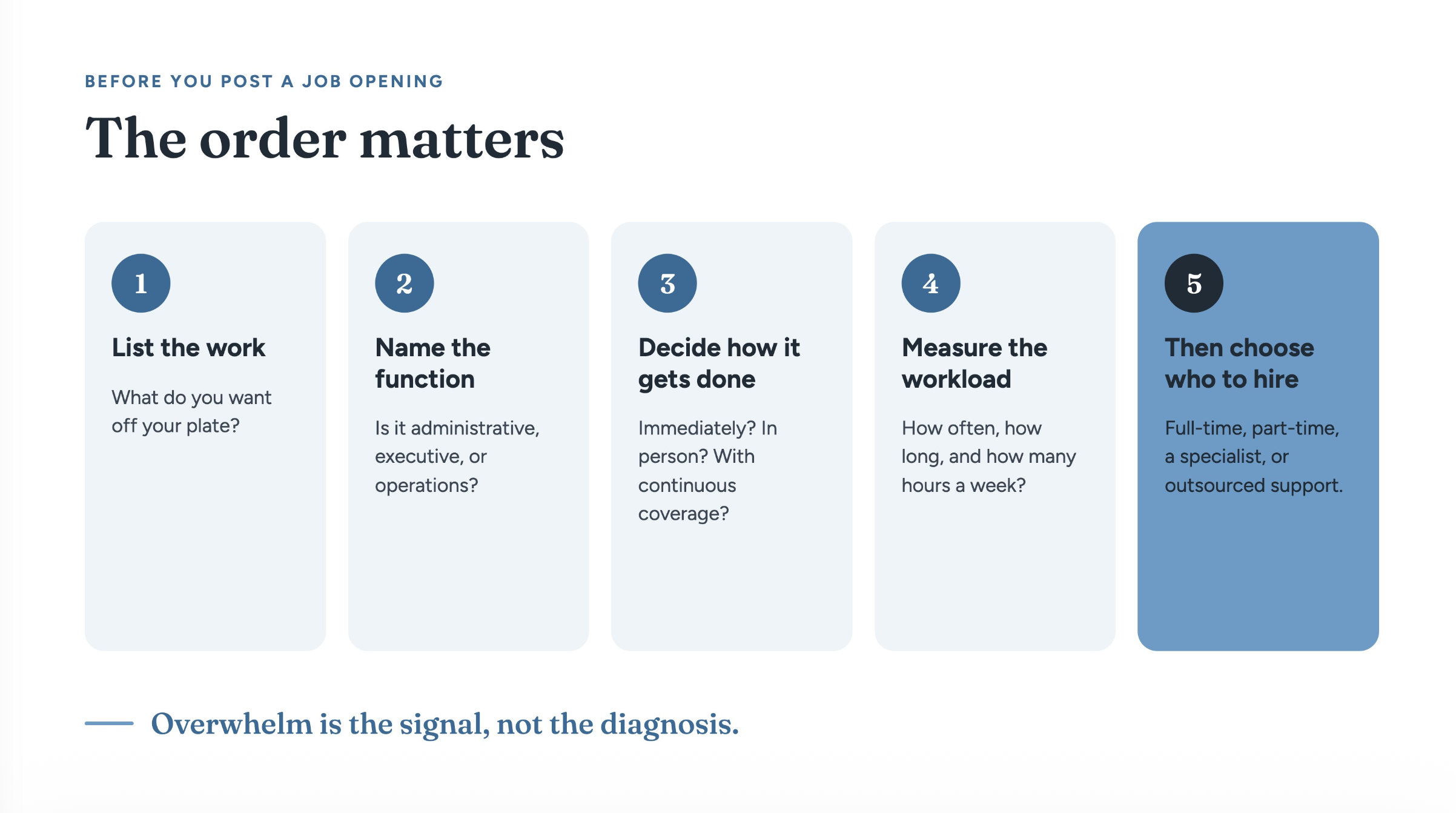
Work through these five steps before you post a job opening.
Overwhelm is the signal, not the diagnosis
When administrative work keeps getting pushed aside, that is usually a sign that something needs to change, but the next step shouldn't automatically be posting a job opening. Start by figuring out what is taking your time, what can be delegated, what function those tasks belong to, and how much support the business realistically needs.
A job title won't fix a workflow problem, but hiring the right function just might.
If you've worked through these steps and found that your business needs consistent administrative support without a full-time workload, that's exactly what CleartheQueue provides. I offer part-time, monthly administrative support for business owners, solo professionals, and small teams, so the routine work gets handled without adding a full-time hire. Book a free consultation to talk through what your business needs.