
Is Hiring a Virtual Assistant Worth It for Your Small Business?
If you run a small business, you've probably considered hiring someone to help with the administrative work at some point. There are emails to answer, appointments to schedule, invoices to send, records to update, and clients to follow up with. None of these tasks necessarily takes much time on its own but together, they can consume a significant part of your workday.
A virtual assistant could take some of that work off your plate, but hiring one means adding another business expense, which raises a reasonable question: would paying someone to handle those responsibilities be worth the time you'd get back, or would you be better off continuing to manage them yourself?
Believe it or not, that answer depends on more than how busy you actually are. Before deciding, it helps to look at how much administrative work you're handling, what it would cost to delegate, and what having that time back would actually mean for your business.
Start by looking at where your time goes
Before deciding whether to hire a virtual assistant, take a closer look at how you're spending your workday. For one week, pay attention to the administrative tasks you handle and approximately how long each one takes. These might include:
responding to routine emails and messages
scheduling or rescheduling appointments
following up with prospective clients
preparing and sending invoices
checking on outstanding payments
updating customer records
organizing documents and files
managing your calendar
You may find that these responsibilities take several hours each week, even if you've never thought of them part of your workload. For example, spending 30 minutes each day responding to routine emails adds up to two and a half hours over a 5-day workweek. Add another hour for scheduling, two hours for billing and follow-up, and an hour updating records, and you're already spending more than six hours a week on administrative work.
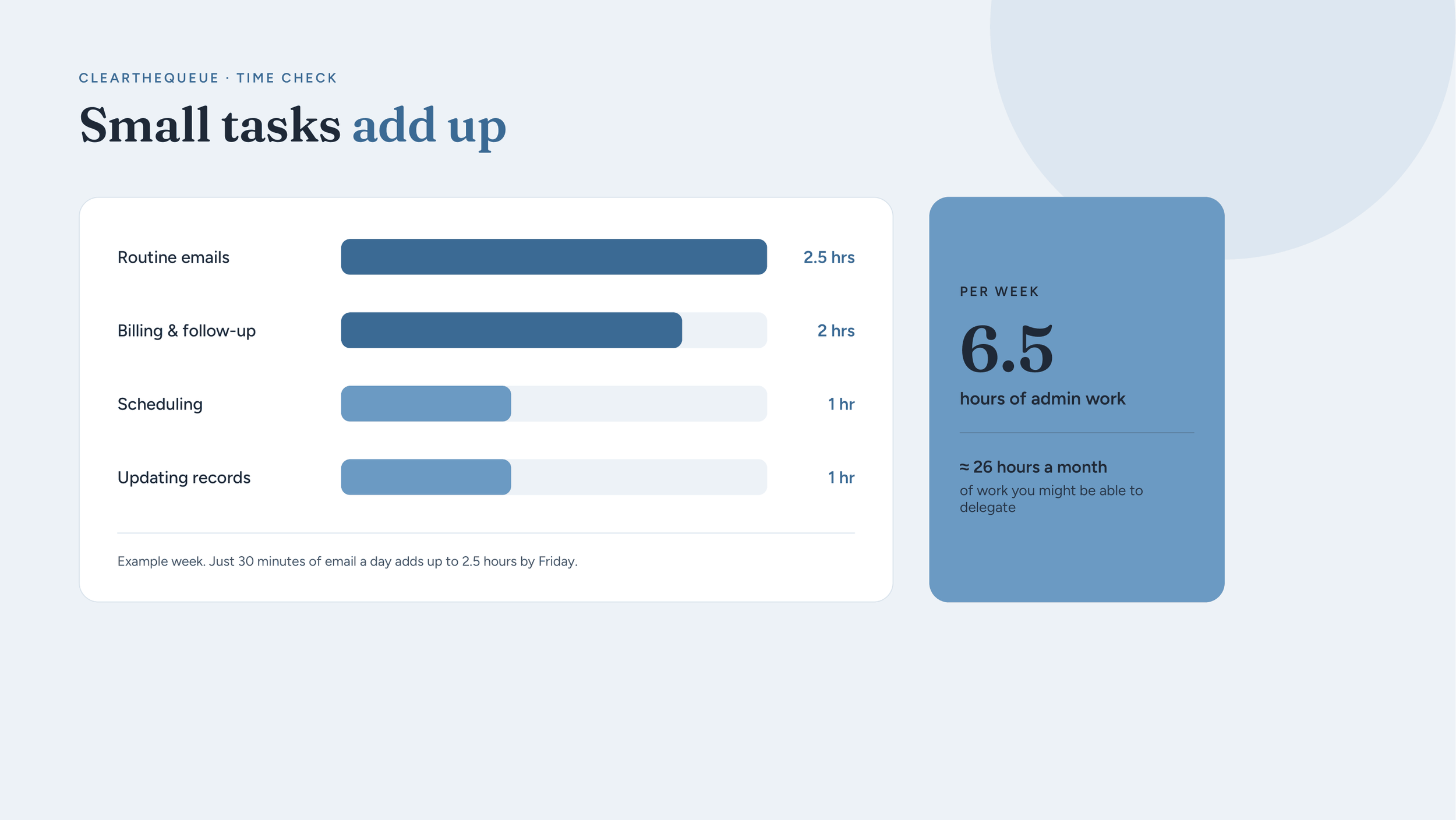
Even small administrative tasks add up. Tracking how much time you spend on them each week can help you determine whether you have enough work to delegate.
That alone doesn't mean you should hire someone right away, but it does give you a clearer picture of how much work exists and what you might be able to delegate.
Think about what you could do with that time instead
One of the most common reasons business owners consider hiring a virtual assistant is to get some of their time back, so it's worth asking what that time would allow you to do.
If you're a consultant, those hours might give you more time to work with clients or prepare proposals. If you're a contractor, they might allow you to spend more time estimating jobs or managing projects. If you run a small professional services business, they might help you keep up with existing client work instead of catching up on administrative tasks at the end of the day.
There’s also value in having routine work completed consistently, even when it doesn't directly generate revenue. Client inquiries get responses, invoices go out on time, appointments are scheduled, and records stay current without requiring you to handle every step personally.
Of course, getting those hours back doesn't necessarily mean you'll earn more money. You might use the time to take on additional client work, focus on growing your business, or simply make your workday more manageable. What's important at this stage is identifying what you'd actually do with the time before deciding whether to pay someone else to handle those responsibilities.
Understand what you're actually paying for
A virtual assistant isn’t an employee, so you won’t pay one the way you’d pay someone on your payroll. Most virtual assistants run their own business or work through an agency, and instead of earning a salary, they charge for the work you agree on. Some charge an hourly rate, some charge a flat fee for a one-time project, and many offer a monthly package that covers a set amount of ongoing support. Because you’re paying only for the help you need, this kind of arrangement can work well for a business that has steady administrative work but not enough to keep someone busy full time.
The easiest way to understand what that means for your business is to put real numbers to it. Say the tasks you tracked earlier add up to about 8 hours a week, or roughly 32 hours a month. If a virtual assistant offers to take over 20 of those hours for $600 a month, you’d be paying about $30 for each hour of work you hand off, and you’d still handle the remaining 12 hours yourself.
That $30 might seem high next to the hourly wage you’d pay an employee, but an employee’s wage isn’t their full cost. Once you add payroll taxes, benefits, and equipment, an employee costs noticeably more than the number on their paycheck. A virtual assistant covers those expenses themselves, so the rate you’re quoted is generally the full amount you’ll pay.
The real question, then, is what you get for that $600. If you bill clients $100 an hour and have enough additional work available, spending six of your 20 recovered hours on paid work would bring in $600 in revenue, matching the cost of the assistant (although revenue isn't the same as profit). If you'd use the time to take some pressure off instead, that can still be worth paying for, as long as the expense fits your budget.
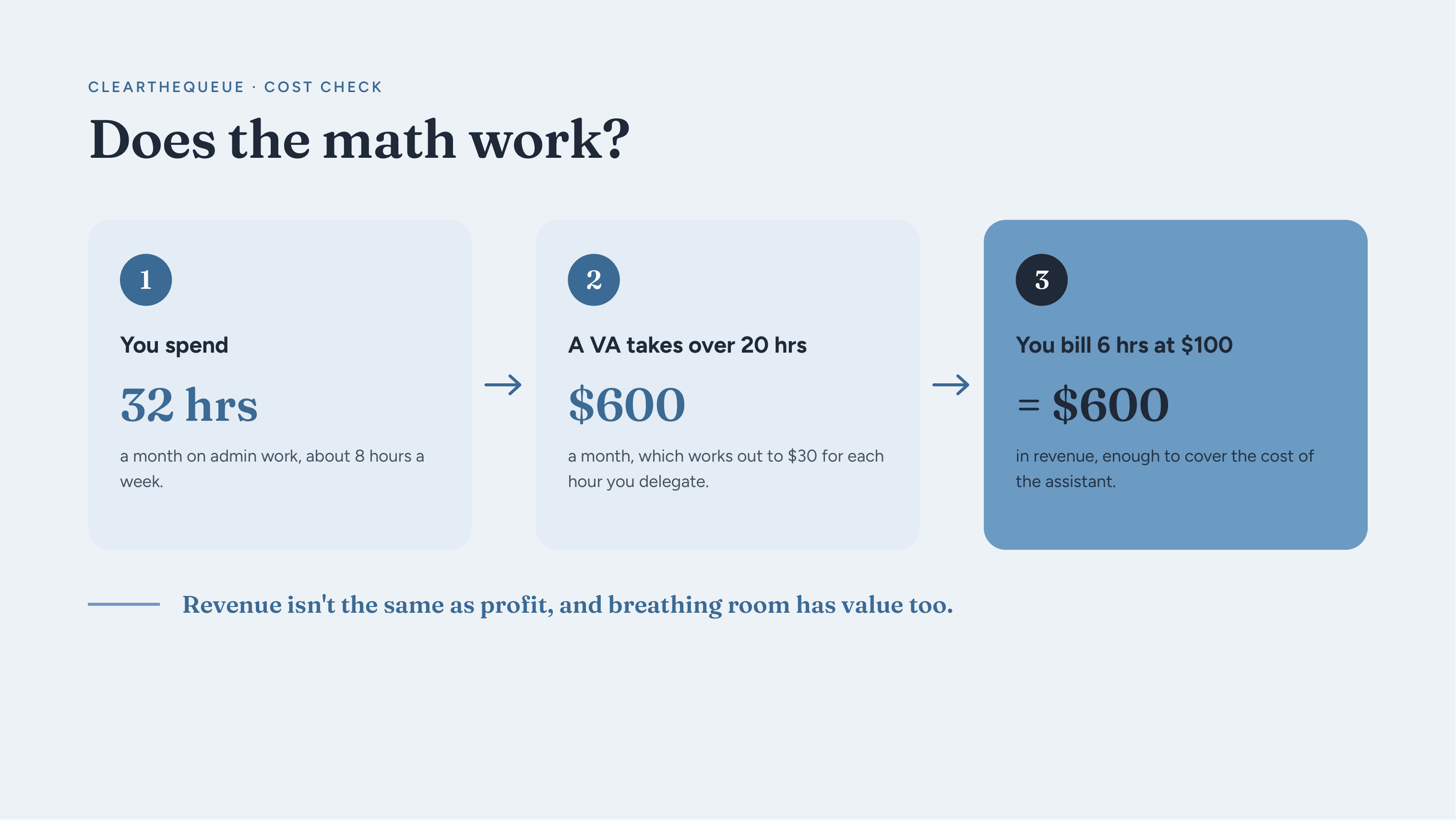
Delegating administrative work comes at a cost, but the time you recover may have financial or practical value. The right decision depends on your workload, budget, and how you'd use those hours.
Account for the time it takes to get someone started
Another consideration is how much time you'll need to spend getting a virtual assistant familiar with your business. Even someone with years of administrative experience won't know how you prefer client inquiries handled, where your records are stored, which appointments take priority, or what requires your approval.
You'll need to provide some direction, access to the appropriate systems, and examples of how you want certain tasks completed. That initial effort can make outsourcing feel less convenient than expected, especially if you're already busy, so it helps to start with a few recurring responsibilities rather than handing over everything at once. For example, you might begin with appointment scheduling, routine inbox management, and invoice follow-up, then decide whether to delegate additional work once those tasks are being handled consistently.
Know when hiring a virtual assistant might not make sense
Virtual assistance isn't the right solution for every business, and being busy isn't necessarily a reason to hire someone. If you only have an occasional administrative task, an ongoing monthly arrangement might cost more than the work justifies, and a one-time project or handling those tasks yourself may make more sense.
If your business requires someone to be physically present, greet customers, manage equipment, or coordinate employees in real time, a remote administrative assistant may not meet those needs. The same applies when the work requires specialized professional expertise. If your biggest problem is accounting, legal work, technical support, or operational management, hiring a general administrative assistant may leave the underlying problem unresolved.
Affordability matters, too. Even when delegating would save time, taking on a recurring expense that your business simply can’t support may create more pressure than it removes. Sometimes the right decision is just to wait, handle a specific project first, or explore a smaller amount of support. The purpose of hiring someone should be to solve a defined business need, not simply to add another person because the workload feels overwhelming.
Decide whether the investment makes sense for your business
By this point, you should have a better idea of how much administrative work you're handling, what you'd gain by delegating it, and what hiring someone would involve.
Before making a decision, ask yourself five questions:
What would I actually delegate? Identify specific responsibilities rather than assuming an assistant will somehow make everything easier.
How much time do those tasks take? Estimate the workload so you know how much support you would need.
What would I do with the time I get back? Consider whether you would use it for client work, business development, managing other responsibilities, or simply reducing your workload.
Can my business afford the expense? Look at the cost as an ongoing business commitment rather than assuming it will pay for itself.
Can I give someone the information they need to do the work? Think about the systems, instructions, access, and communication required to make delegation successful.
You don't need a complicated return-on-investment calculation to make this decision. You need a clear understanding of what you're handing over, what it will cost, and why having someone else handle it would be useful.
If the answers point toward a manageable workload and an expense your business can support, hiring a virtual assistant may be worth exploring. If not, revisit the decision when your needs or circumstances change.
Not sure whether hiring a virtual assistant makes sense for your business? CleartheQueue offers ongoing remote administrative and personal assistant support for solo professionals and owner-operated businesses. Book a free 30-minute consultation to discuss the work you're currently handling and whether delegating some of it would be a practical fit.